Customer Portal: A Scalable Platform for Technical Users
What is it?
Designing EdgeUno’s Customer Portal
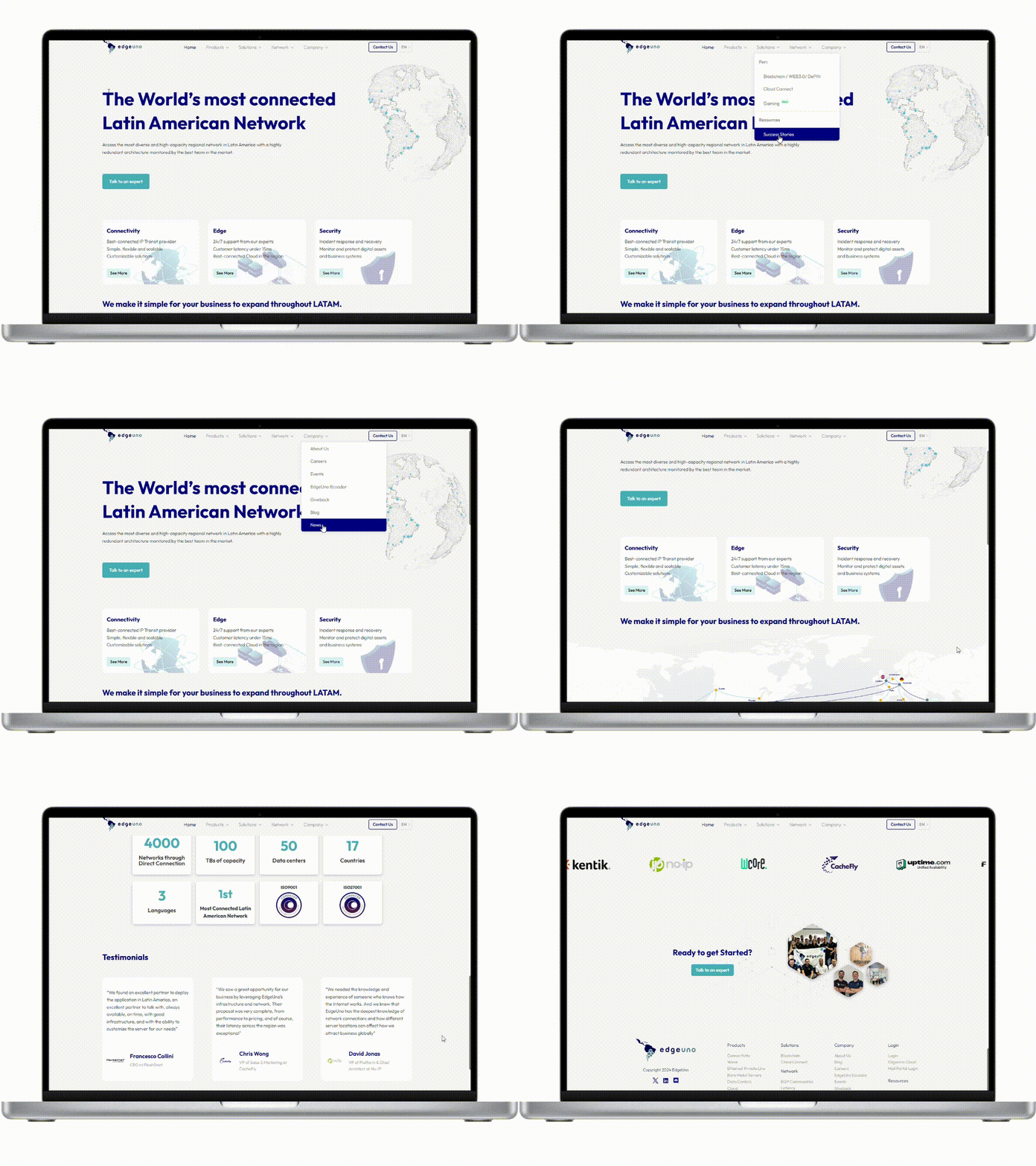
I led the full redesign of EdgeUno’s website and brand identity, focusing on improving SEO, conversion rates, and user experience. The project delivered a modern, scalable design system, optimized content, and measurable impact — including a 354% increase in new users and a major boost in campaign performance.
Contributions
- End-to-End UX Ownership: led the entire design process — from discovery, research, and user flows to wireframes, high-fidelity prototypes, and final handoff.
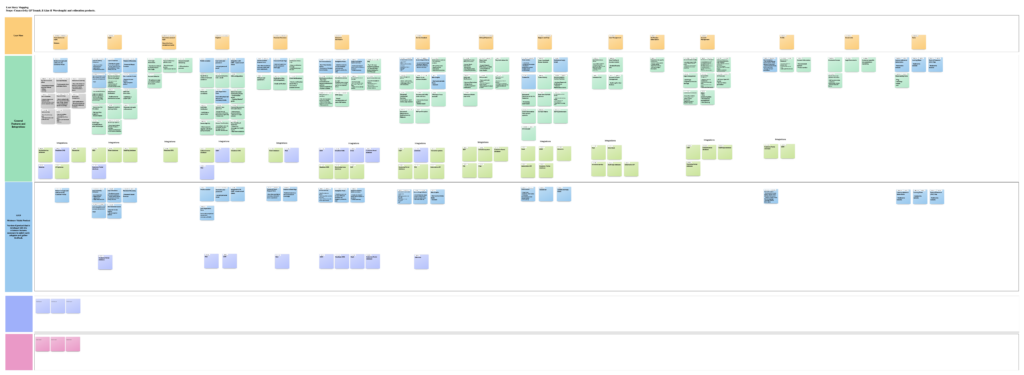
- User Research & Story Mapping: conducted interviews, analyzed platform data, and built detailed user stories to guide feature prioritization and roadmap planning.
- Mobile-First UI Design: designed a fully responsive, mobile-first interface in Figma based on behavioral insights showing 90%+ mobile access.
- Design System Development: created a scalable, component-based design system aligned with the dev team’s stack (React, Next.js, Tailwind) to speed up implementation.
- UX Writing & Content Strategy: wrote all platform copy with a focus on clarity, technical accuracy, and localization-readiness for LATAM audiences.
- Cross-Team Collaboration: worked closely with developers, PMs, and marketing across weekly sprints to ensure alignment, technical feasibility, and business impact.
- Integration Alignment: helped define interface behavior around complex backend integrations (CRM, LibreNMS, billing systems, APIs, etc.).
Results & Impact
The website redesign directly contributed to a major leap in EdgeUno’s digital performance:
The project is in active development, with MVP features completed and rollout in progress. Internally, the shift to mobile-first thinking has already improved dev speed, reduced rework, and enabled tighter QA loops across responsive breakpoints.
Stakeholders — especially those in customer success and technical delivery — reported that the new designs directly addressed customer frustrations with the old mobile experience. Feedback has emphasized the clarity, speed, and ease-of-use across the mobile prototypes, particularly for users accessing dashboards while in the field or traveling.
This project builds on the success of the EdgeUno website redesign, which achieved a 354% increase in user growth. The Customer Portal is expected to push that impact even further by offering a truly accessible experience to the company’s most active and technical customers — directly on the devices they use most.
Overview
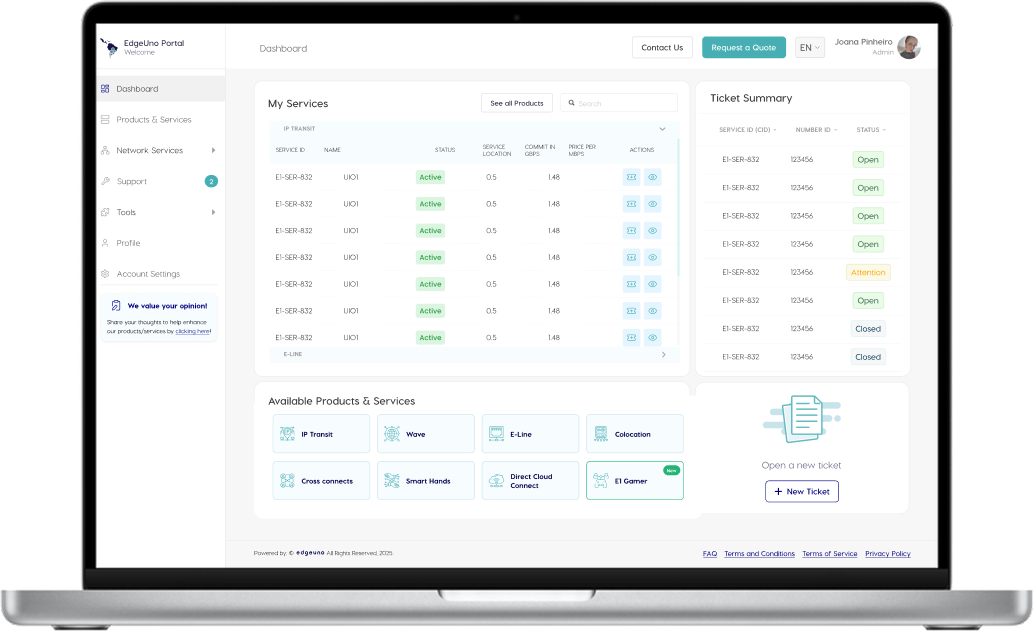
The EdgeUno Customer Portal is a centralized self-service platform for enterprise customers managing connectivity services such as Colocation, IP Transit, and Edge solutions. The portal was designed to unify critical workflows — from support tickets and service health to billing, contracts, and advanced technical tools — into one intuitive platform.
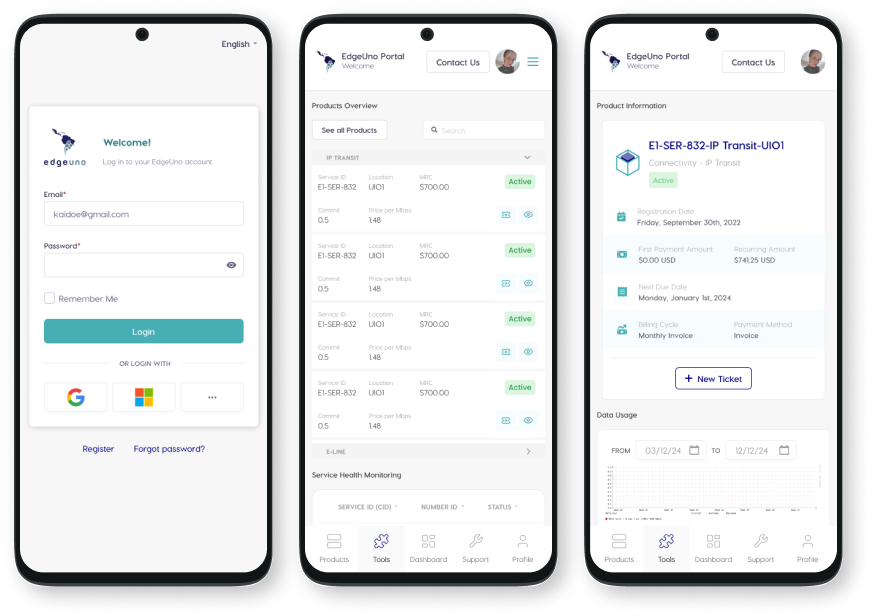
From the earliest stages of research, we discovered that over 90% of users accessed the existing system via mobile devices. This insight became a cornerstone of our strategy: the portal needed to be designed mobile-first — not as a responsive afterthought, but as the primary experience. My role covered the full design lifecycle, ensuring the product was not only powerful but also fully usable and accessible on small screens without compromise.
Goals
- Build a seamless mobile-first interface tailored for on-the-go infrastructure professionals
- Create a centralized platform that unifies support, billing, service delivery, and API tools
- Reduce support workload by improving clarity and introducing smarter self-service flows
- Ensure performance across all devices, especially under low-bandwidth conditions common in some LATAM regions
- Align with EdgeUno’s brand and scale easily across technical user roles and account types
Design Process
Discovery & Research
We kicked off the project with in-depth research, combining stakeholder interviews and analytics reviews. A major insight emerged from user behavior data: more than 90% of interactions happened on mobile, often in real-time, in the field, or while monitoring live issues. This drastically shaped how we approached UX prioritization, interface design, and navigation structure.
In parallel, we benchmarked similar platforms — IaaS, CDNs, and telecom dashboards — to understand how technical users consume information on mobile and where those platforms fall short.
UX Strategy & Architecture
Based on the research, I led a User Story Mapping exercise across key personas — technical engineers, financial admins, and EdgeUno partners. We defined actions by user type and release phase (MVP to v3.0) and mapped mobile-first flows accordingly. To support usability on small screens, I simplified the site architecture into logical task-based groups and ensured that no primary action required more than three taps to complete.
UI Design & Mobile Prototyping
I designed the entire portal experience in Figma, focusing first on mobile before scaling to desktop. Layouts prioritized tap targets, collapsed content into smart sections, and included visual indicators that would work clearly in a compact space (e.g., service status chips, dropdown summaries).
The dashboard was modular, customizable, and responsive — adapting seamlessly from small to large screens. Every core feature, from BGP session reviews to invoice disputes, was built to be usable on a smartphone without sacrificing power or clarity. I also wrote all UX copy, making sure the language was concise and supportive, especially in technical workflows.
Developer Collaboration & Iteration
Because of the mobile-first approach, I collaborated closely with frontend devs to validate feasibility using React, Next.js, and Tailwind, and helped them align component behavior across screen sizes. I provided annotated Figma files, ran alignment reviews weekly, and documented all mobile-first patterns and constraints directly into our design system.
Key Features
- Mobile-Optimized Dashboard with service status, billing summaries, and open support tickets
- Granular Role-Based Access Control (RBAC), including views and actions adapted by role
- Self-Service Workflows for services like BGP management, remote hands, and datacenter access
- Technical Tools including latency matrix, Looking Glass, and PoP reference map — all responsive
- Finance & Contracts Section with downloadable invoices, real-time payment status, and dispute workflows
- Real-Time Alerts and Notifications, accessible via mobile and customizable per user
- API Access to export data into external monitoring platforms
Tools & Stack
- Design: Figma (mobile-first prototypes), Lucidchart, Office Whiteboard
- Frontend: React.js, Next.js, Tailwind
- CMS & Integrations: Strapi, CRM
- Collaboration: Jira, GitLab, Sprint Reviews, Dev Syncs
Conclusions
This project challenged me to bring together strategy, design, communication, and execution at a high level. It demonstrated my ability to lead complex, cross-functional initiatives while keeping user needs and business goals at the center of every decision. From defining scalable systems to crafting accessible, developer-focused experiences, the EdgeUno Customer Portal represents the kind of product design I’m passionate about — intentional, collaborative, and built to deliver long-term value.
UX Strategy
Leading the UX strategy from day one, I conducted stakeholder interviews, mapped user stories, and prioritized features based on both technical users’ needs and business impact. This allowed me to define a scalable product roadmap and ensure that each release phase — from MVP to v3.0 — delivered real value. The portal structure was based on real workflows, not assumptions, which helped improve usability from the start.
Interface Design & Systems Thinking
I created a modular, responsive design system in Figma aligned with the dev team’s tech stack (React, Next.js, and Tailwind). The interface was designed to handle dense information without overwhelming the user — from real-time service dashboards to contract summaries and billing status. By using components and tokens, I ensured design consistency and faster implementation across releases.
UX Writing & Content Strategy
I was responsible for all UX writing across the portal. This included everything from onboarding flows and button labels to tooltips and status messages. I wrote with clarity, precision, and localization in mind, knowing that our users speak multiple languages and work in fast-paced, technical environments. Content was designed to guide users without friction, even in complex workflows like BGP management or ticketing.
Cross-functional Collaboration
Throughout the project, I worked closely with product managers, developers, marketers, and customer success teams. Weekly sprint check-ins, shared whiteboards, and annotated Figma files helped maintain alignment across departments. I ensured that every feature — from CRM syncs to technical ticketing — was grounded in real-world feasibility and supported by everyone involved.
End-to-End Product Design
This project is a clear example of my ability to lead the entire design process — from discovery and concept, through prototyping and feedback, to supporting implementation. It required balancing deep technical content with usability, collaborating across time zones, and shipping under tight deadlines. It also reaffirmed my passion for building design solutions that scale with both user and business growth.
Explore My Work
From ideas to interfaces — here are some of my favorite builds
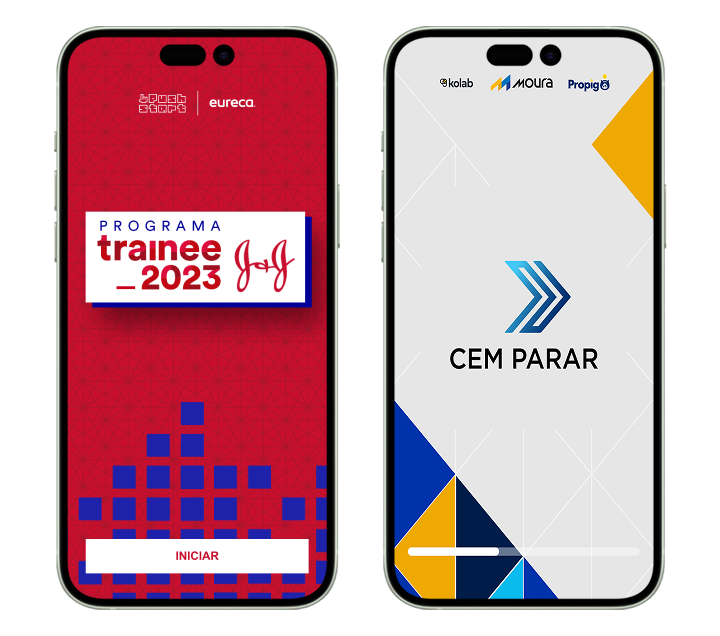
Smart, gamified solutions for Talent Recruitment & Employee Training
Saas Product Design
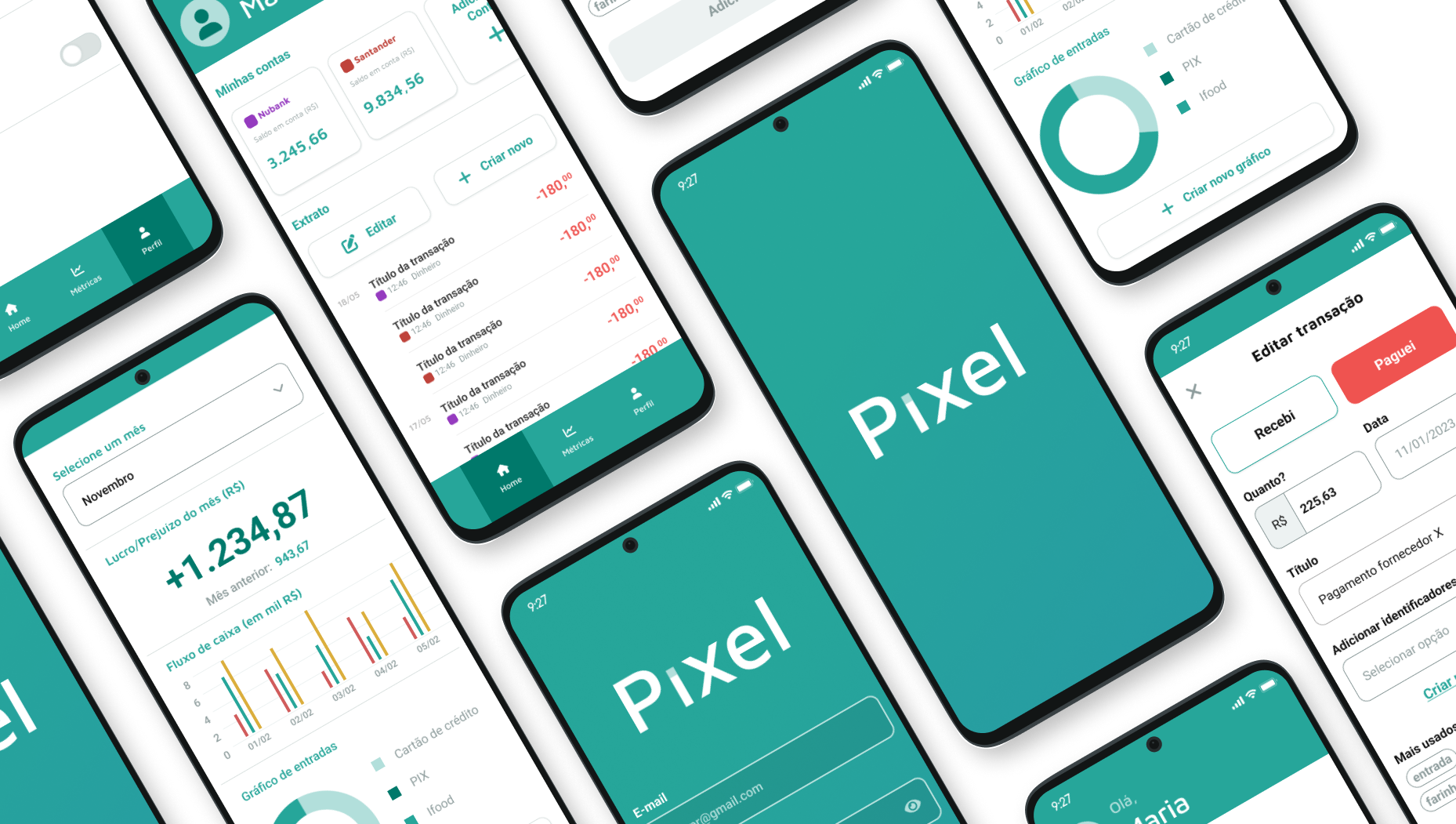
Fintech Product B2b SaaS
Pixel